
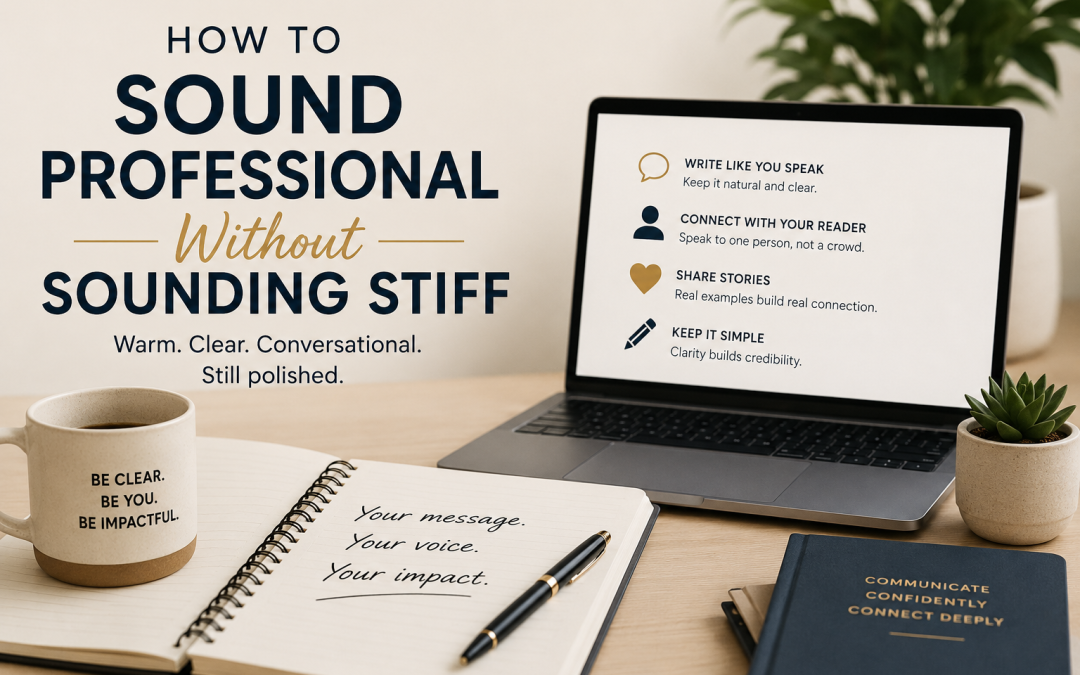
Many coaches, consultants, and speakers fall into the trap of trying to sound “professional” by writing as if they are preparing a corporate policy manual or letter. The result is content that may be technically correct but difficult to connect with. Readers skim it, feel no emotional connection, and move on.
Professional writing tips include letting go of the belief that you have to sound cold, stiff, or distant. In fact, the people who attract clients most effectively often sound approachable, clear, and confident. Their writing feels like a smart conversation, not a lecture.
If your emails, blog posts, website copy, or LinkedIn content sound more formal than human, there are ways to correct that without sacrificing credibility.
Here are several professional writing tips on how to sound polished while still sounding like yourself.
Write Like You Speak—With Editing
One of the easiest ways to loosen overly formal writing is to imagine you are explaining your idea to a client over coffee. Most people speak more naturally than they write. In conversation, you probably do not say:
“Today I would like to discuss several strategies that may potentially assist business owners in achieving improved visibility.”
You would more likely say:
“Today I want to share a few ways business owners can become more visible.”
The second version sounds clearer and more direct. It also sounds more confident.
That does not mean your writing should become sloppy or filled with slang. The goal is conversational clarity. A simple test is to read your writing out loud. If you do not sound like yourself, the wording probably needs adjustment.
Stop Hiding Behind Big Words
Some professionals believe complicated language makes them sound smarter. Usually, it has the opposite effect. Readers are busy. They appreciate writing that gets to the point quickly.
Instead of writing:
“Your organization may experience difficulty maintaining consistent audience engagement.”
Try:
“You may have trouble keeping your audience engaged.”
Shorter words create stronger writing. Clear writing signals confidence because it shows you do not need complicated wording to prove your expertise.
Strong professionals explain complicated ideas simply.
Use Contractions
Contractions instantly make writing sound more natural. Compare these two examples:
“You will discover methods that are effective for increasing client retention.”
“You’ll discover methods that work for keeping clients longer.”
The second version sounds more relaxed while still sounding professional.
Many people were taught that contractions were inappropriate in business writing. I’ve had people tell me that. That advice belongs to another era. Today’s readers expect communication that feels human.
If every sentence sounds rigid, readers feel the distance. Contractions help close that gap.
Cut Unnecessary Formalities
Overly formal introductions weaken writing.
Phrases like these add very little value:
- “I would like to take this opportunity to discuss…”
- “It is important to note that…”
- “At this point in time…”
These phrases delay the message. Stronger writing gets to the point faster:
“Many consultants lose potential clients because their writing feels impersonal.”
That sentence immediately tells the reader why they should keep reading.
The same principle applies to emails. Long greetings and excessive niceties can create friction. Warmth matters, but readers also appreciate efficiency.
Sound Confident Without Sounding Arrogant
There is a difference between authority and ego. Weak writing often sounds hesitant:
“You might possibly consider trying…”
Strong writing sounds decisive:
“Try this approach instead.”
You do not need to apologize for your expertise. Business professionals are hired because people want guidance.
At the same time, avoid sounding like you have all the answers for every situation. Readers respond best to confidence paired with humility.
A phrase like, “Here’s what I’ve seen work consistently with clients…” sounds grounded and credible.
Use Stories and Examples
Nothing softens stiff writing faster than examples. Stories create connection. They also help readers understand abstract ideas.
Instead of explaining communication principles in general terms, show readers what happens in real life.
For example:
“I once reviewed a consultant’s website that used phrases like ‘innovative strategic methodologies’ throughout the home page. After rewriting the copy in plain English, inquiries increased because visitors finally understood what the consultant actually offered.”
That example paints a picture readers can remember.
People hire people, not polished robots.
Avoid Corporate Language
Corporate jargon creates distance between you and your audience. Words and phrases like these often weaken writing:
- Synergy
- Thought leadership
- Cutting-edge solutions
- Robust framework
- Value-added services
These expressions have become so overused that readers often skip past them without absorbing meaning. Specific language works better. Instead of saying:
“I provide customized leadership solutions.”
Say:
“I help business owners communicate more clearly with their teams.”
The second version is easier to understand and much more persuasive.
And be careful about using legal language, especially when angry. I once wrote a private email asking a person to cease and desist spreading confidential information. My anger-fueled email was ill-advised. The recipient then sent my email to 100 people who started bombarding me with questions about why I’d sent that email. My angry email made a bad situation worse.
Let Your Personality Show
Overuse of AI-generated writing, without appropriate editing, can sound robotic. And many professionals strip all personality out of their writing because they fear sounding unprofessional. The opposite is usually true.
Readers remember writing that sounds human. A touch of humor, honesty, or personal observation can make your content more engaging. You do not need to become overly casual. You simply need to sound real.
If you are naturally warm in conversation, let that warmth appear in your writing. If you are direct and practical, write that way.
Professional writing means that consistency matters more than perfection.
Edit for Clarity, Not Impressiveness
After finishing a draft, ask yourself these questions:
- Would I actually say this out loud?
- Can this sentence be shorter?
- Am I using jargon instead of clarity?
- Does this sound like a real person wrote it?
 Professional writing is not about sounding important. It is about communicating ideas clearly enough that readers trust you.
The coaches, consultants, and speakers who stand out today are often the ones who sound approachable, intelligent, and authentic all at once.
Your readers do not want a lecture.
- They want clarity.
- They want connection.
- They want to feel that there is a thoughtful human being behind the words.
That combination is what turns readers into clients.
Discover more of why writing skills help you advance in your business. Order Why Become a Better Writer Today at this link.

Pat Iyer MSN RN LNCC is a consultant, speaker, author, editor and coach. She has written or edited 73 of her own books and worked with dozens of authors as an editor. Her most recent books include AI-Powered Video for LNCs book and workbook. She is the author of Blogging for Legal Nurse Consultants: Share Your Knowledge and Attract Clients.
Pat is an Amazon international #1 bestselling author. Coaches, consultants, and speakers hire Pat to help release the knowledge inside them so that they can attract their ideal clients.
She delights in assisting people to share their expertise by writing. Pat serves international and national experts as an editor, book coach, and a medical and business writer.