

Some business owners believe they have nothing interesting to write about. They assume great content comes from dramatic events, celebrity clients, or extraordinary accomplishments. As a result, they stare at a blank screen, wondering what to post next.
The truth is much simpler. The best business stories are usually hiding in plain sight. They happen during client conversations, while solving problems, after making mistakes, or during moments that changed the direction of a business. These experiences are often far more relatable and persuasive than polished success stories.
If you’re a coach, consultant, speaker, author, or service professional, your everyday experiences can become a steady source of content that builds trust and demonstrates your expertise.
Here are some of the most valuable stories you can tell.
Business Stories About Client Interactions
Every client interaction contains potential content. You don’t need to reveal confidential details. Instead, focus on the challenge, the process, and the lesson.
Perhaps a client asked a question you’ve heard dozens of times. That question likely represents a concern shared by many prospects.
Maybe a client misunderstood an aspect of your service. Explaining how you clarified the issue could make a useful educational article.
You can also write about common patterns you observe. For example:
- The mistakes clients make before hiring you
- The misconception that slows their progress
- The questions they should ask but rarely do
- The concerns that keep appearing repeatedly
- The unhelpful way a customer service representative responded to your concern
These stories help readers see themselves in your content while positioning you as a knowledgeable guide.
Business Stories About Mistakes
Many business owners avoid discussing mistakes because they fear appearing unprofessional. In reality, thoughtfully sharing mistakes often increases credibility.
I’ve written blogs about my mistakes in the courtroom when testifying as an expert. The comments I got showed me that others related to my experience.
People connect with honesty. They appreciate learning from someone who has encountered challenges and found solutions.
Perhaps you:
- Underpriced your services
- Said yes to the wrong client
- Missed a deadline
- Chose ineffective or expensive marketing strategies
- Invested in the wrong technology
The value isn’t in the mistake itself. The value is in what you learned and how your approach changed afterward.
A story about a costly error can often attract more attention than a story about effortless success because readers recognize their own fears and experiences in your journey.
Stories About Surprising Outcomes
Unexpected results make excellent content. I learned early in my business not to say or think I failed. Instead, I achieved an unexpected outcome. These stories often begin with assumptions that turned out to be wrong.
Maybe you expected one marketing strategy to perform well, but a completely different approach generated the best results. For example, I spent several years paying thousands of dollars for full-page ads in advertising supplements that went into newspapers for lawyers. When I took that money and invested in gifts for my top clients, I got far better results.
Perhaps a client came to you with one problem, only to discover a deeper issue that needed attention. Surprising outcomes capture attention because they challenge conventional thinking. They also provide an opportunity to share insights your audience may not have considered.
When telling these stories, explain:
- What you expected
- What actually happened
- Why the outcome surprised you
- What lessons others can apply
This structure creates a natural narrative that keeps readers engaged.
Business Stories About Turning Points
Every business has defining moments. These are the decisions, events, or experiences that changed your direction.
Examples might include:
- Leaving a traditional job to start a business
- Writing your first book
- Landing your first major client
- Speaking at an important event
- Making a significant investment
- Rebranding your company
- Having difficulty collecting money from a client
Turning-point stories reveal the human side of your business. They help readers understand your values, motivations, and decision-making process.
More importantly, they often inspire readers who may be facing similar choices in their own careers.
Stories About Lessons Learned
Some of the most effective content begins with a simple realization. You learned something. Now you can share that lesson with others.
The lesson might come from:
- A conference you attended
- A conversation with a client
- A book you read
- Feedback you received
- An unexpected challenge
- A performance issue you faced
- An interaction with an angry client
These stories do not need to be lengthy. In fact, some of the best lessons can be shared in a few hundred words.
Start with the experience, explain what happened, and then connect it to a broader principle your audience can apply.
This approach turns ordinary events into useful content.
Stories About What Happens Behind the Scenes
- How you prepare for a presentation
- Your writing process
- How you conduct client research
- The steps involved in creating a product
- How you organize projects
These stories help people appreciate the expertise involved in your work. They also make your business feel more approachable and authentic.
Many professionals overlook these experiences because they seem routine. Yet what feels ordinary to you may be fascinating to someone who has never seen your process.
Stories About Small Wins
Not every story needs to feature a dramatic breakthrough. Small wins often resonate because they feel achievable.
- A client gained confidence.
- A presentation generated positive feedback.
- A new system saved time.
- A difficult project finally came together.
These stories remind readers that progress often comes through a series of smaller successes rather than a single life-changing event. They create momentum and optimism without sounding exaggerated.
How to Capture Story Ideas Before You Forget Them
One reason business owners struggle with content is that they fail to record business story ideas when they occur.
Start keeping a simple running list. Whenever something interesting happens, jot down a few notes.
Ask yourself:
- What surprised me today?
- What question did someone ask?
- What problem did I solve?
- What lesson did I learn?
- What challenged my assumptions?
- What would help someone else avoid a mistake?
You don’t need a complete article. Just capture the idea with enough detail that you will remember what you want to share when it is time to write up the story. Over time, you’ll build a collection of content topics drawn directly from real experiences.
 Your Business Is Already Full of Stories
The most powerful stories are rarely invented. You discover them. Every client conversation, lesson learned, challenge overcome, and unexpected outcome creates material you can use to educate, connect, and build trust.
Instead of asking, “What should I write about?” ask a different question: “What happened this week that taught me something worth sharing?”
The answer will often provide better content than any brainstorming session. Your business experiences are not distractions from your content strategy. They are your content strategy.
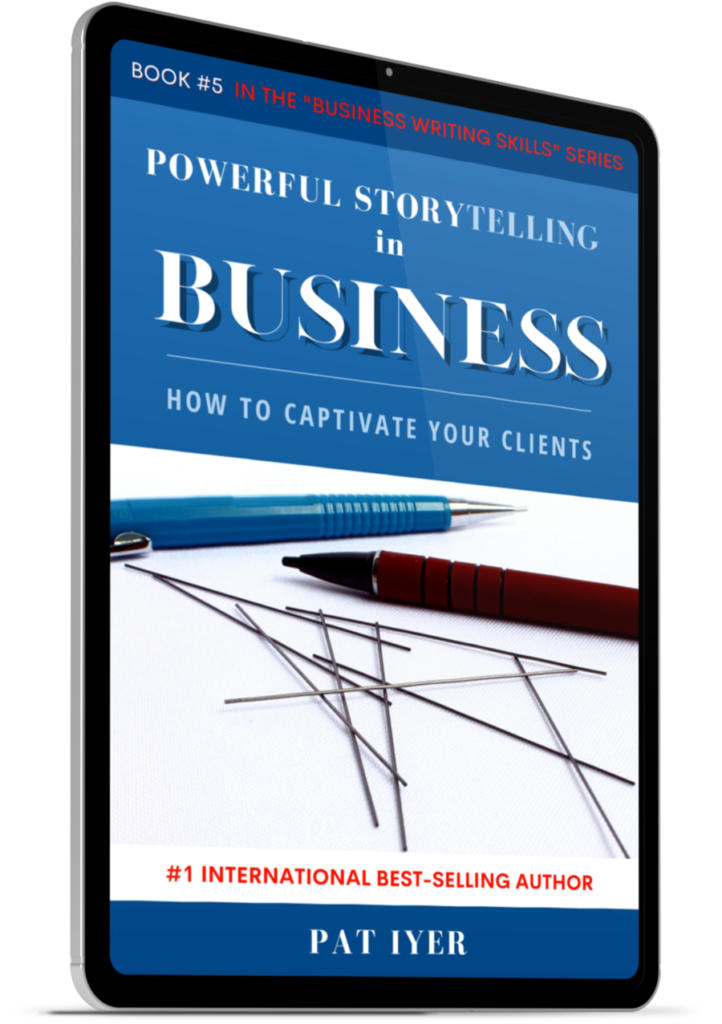
Get the concrete details that make business story-telling effective by ordering my book, Powerful Storytelling in Business: How to Captivate Your Clients. Get it at this link.

Pat Iyer MSN RN LNCC is a consultant, speaker, author, editor and coach. She has written or edited 73 of her own books and worked with dozens of authors as an editor. Her most recent books include AI-Powered Video for LNCs book and workbook. She is the author of Blogging for Legal Nurse Consultants: Share Your Knowledge and Attract Clients.
Pat is an Amazon international #1 bestselling author. Coaches, consultants, and speakers hire Pat to help release the knowledge inside them so that they can attract their ideal clients.
She delights in assisting people to share their expertise by writing. Pat serves international and national experts as an editor, book coach, and a medical and business writer.