A client of mine — a consultant with twenty years of experience — sent me an outline for her book. It had an outline of 47 chapters.
Forty-seven.
She was drowning in ideas and felt she had to include everything. Every framework she’d ever taught, every client story, every LinkedIn post that got a good response — she wanted them all in the book. Her ideas for her book were too broad, too involved, and too ambitious.
If you are knowledgeable about a specific area, that instinct makes sense. You’ve spent years building expertise; everything feels relevant. The problem is that a book with 47 chapters isn’t a book. It’s a filing cabinet. Few people seeing the size of the book are likely to open it.
If you’re an expert sitting down to write your first business book, you likely don’t have a blank-page problem. You have the opposite one: too much material, too many angles, no clear line through the middle.
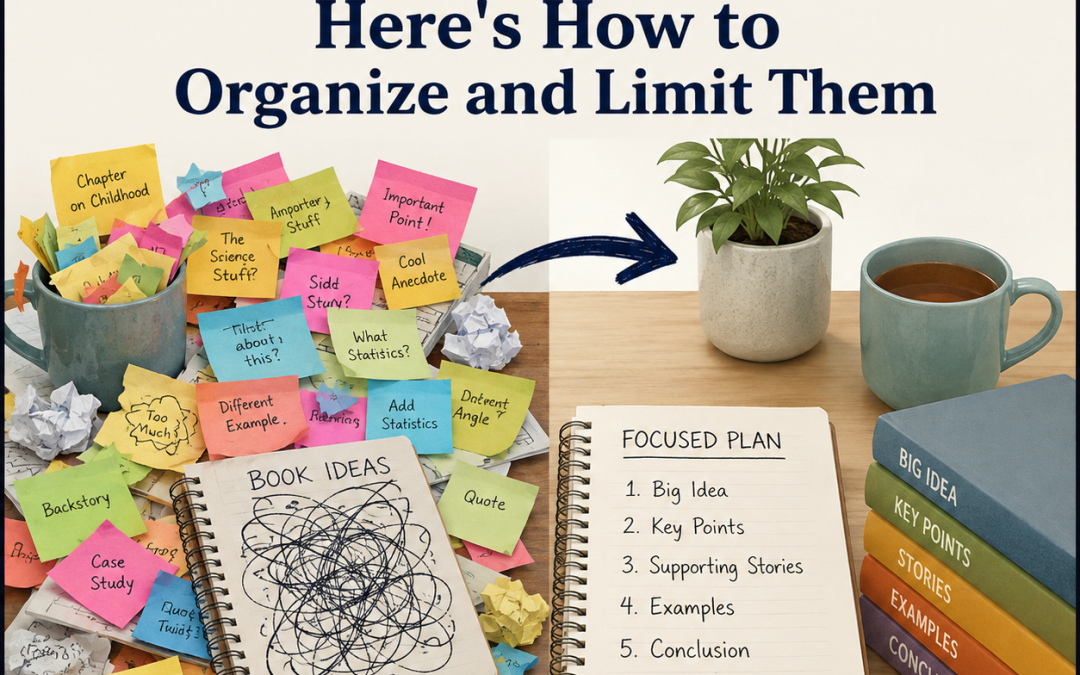
Here’s how to bring it down to size.
Too Many Book Ideas Is a Sign You’re Ready, Not a Problem to Fear
First, let me give you some reassurance. Having more material than you can use means you have deep expertise — not a lack of it. Your struggle isn’t a signal to wait until you “figure out what the book is really about.” It’s a signal that you need a filter, not more thinking time to come up with new ideas for content.
Most professionals in this position try to solve it by writing faster, hoping the book will organize itself as they go. It won’t. This approach creates a disorganized mess. Your organizing must happen before you write, or you’ll rewrite the same three chapters five times and unintentionally duplicate material in your chapters.
Start With One Reader
Your book doesn’t need to contain everything you know. It needs to solve one problem for one reader.
Ask yourself: who is this book for, specifically? Not “business owners” or “leaders.” Picture one person — the client you helped last year, the one who came to you stuck at a particular point, with a specific fear. What did they need to hear first? What did they need to hear last?
Create an avatar of that ideal reader. Describe their age, sex, occupation, fears, frustrations, and challenges. Assign them a name.
Test every idea you’re holding onto against that one reader. If it doesn’t serve their specific problem, it doesn’t belong in this book. It might belong in your next one, or in a blog post, or in a keynote. It doesn’t have to disappear. It just doesn’t belong here.
Sort Ideas Into Three Piles
Once you can envision your reader, go through your list of topics — all 47 of them, if that’s where you are — and sort each one into three categories:
- Core: Directly answers the reader’s central problem. This is the heart of your book.
- Supporting: Adds depth or nuance to a core idea but isn’t the main point. These become subsections, not chapters.
- Someday: Interesting, true, and not for this book. Save the ideas; don’t delete them.
Most people find that only a third of their original list belongs in the “core” pile. That’s normal. A book with too many book ideas that tries to cover everything ends up teaching nothing memorably. A business book built around five or six core ideas, explained and organized well, is the one readers actually finish and recommend.
Build the Heart Before You Build the Chapters
Once you have your core ideas, put them in order. Not the order you thought of them — the order your reader needs them. What does your reader need to understand first for the second idea to land? What problem do you need to name, explain, illustrate, and expand upon before you offer the fix?
I ask clients to write this sequence as a single sentence for each core idea: “The reader needs to understand X before they can do Y.” If you can’t complete that sentence, the idea probably isn’t core after all — it’s supporting material, and it moves to that pile.
This is the same discipline I use with clients converting a blog archive into a book. Their material already exists. The work is deciding what stays, what supports, and what waits.
Your Discipline Creates the Book
Here’s the part nobody tells you: cutting good material feels like a loss, even when you know it’s the right call. It isn’t. A reader who finishes your book and understands five ideas deeply will hire you, quote you, and recommend you. A reader who abandons your book at chapter 12 out of 47 won’t.
Your job isn’t to include everything you know. It’s to choose what this particular reader needs, in the order they need it, and to trust that the rest of your material will have a home somewhere else.
If you’re staring at a list like my client’s 47 chapters, start there. Pick your one reader. Sort your ideas into three piles. Build the sentence that connects each core idea to the next. Then your book will get shorter and better. And you are more likely to finish writing a shorter book than to stare at a list of 47 chapters. The book in the hands of your reader has more power than a book that stays in your head.
Working through your own list of ideas and not sure what belongs? That’s exactly the kind of sorting a second set of eyes helps with — reach out if you’d like help mapping your book’s heart.
 Pat Iyer MSN RN LNCC is a consultant, speaker, author, editor and book coach. She has written or edited 73 of her own books and worked with dozens of authors as an editor and book coach. Her most recent books include AI-Powered Video for LNCs book and workbook.
Subscribe to Pat’s Substack account at this link for her latest posts and notes on The Writer’s Toolbox.
Pat is an Amazon international #1 bestselling author. Coaches, consultants, and speakers hire Pat to help release the knowledge inside them so that they can attract their ideal clients.
She delights in assisting people to share their expertise by writing. Contact her at http://patiyer.com/contact.
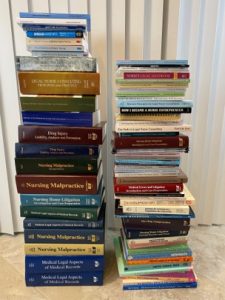
Below is a pile of some of Pat’s books.