
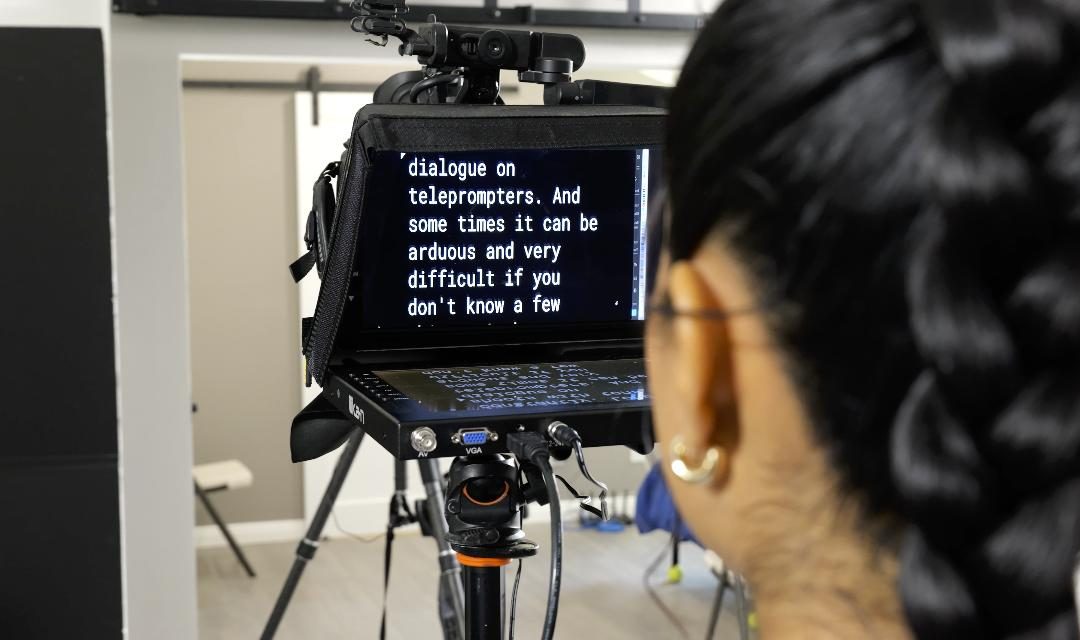
Karli had delivered the same talk to live audiences a dozen times. Her clients nodded along, asked good questions, and booked discovery calls afterward. So, when she recorded a webinar version of that talk, she did what seemed logical: she began writing scripts of her presentation word-for-word and read it from a teleprompter.
The result sounded like a hostage reading a ransom note.
Her sentences, which worked fine on paper, were too long for her to say without running out of breath. The app she used with her teleprompter wasn’t voice-activated, so when she paused for a breath, the script kept rolling. This forced her to speak at an unnatural pace to keep up with the script.
Her transitions, smooth in writing, sounded clunky out loud. And her audience, watching a recorded version of a talk that used to feel alive, dropped off halfway through.
Karli’s mistake in writing scripts is common among coaches, consultants, and speakers who are strong writers. They assume that good writing and good spoken content follow the same rules. They don’t.
Writing for the Eye vs. Writing for the Ear
When someone reads your blog post, they can pause, reread a confusing sentence, or skim ahead. When someone watches your video or sits through your webinar, that cannot happen. They hear your words once, in real time, and they either follow along or they don’t.
This changes almost everything about how you should approach writing scripts.
A sentence that reads cleanly on the page can be impossible to deliver naturally out loud. A clever turn of phrase that lands in writing can sound stilted when spoken and vice versa.
And a paragraph that makes sense visually, with line breaks and punctuation guiding the eye, can become a confusing run-on mess the moment it leaves your mouth.
Read Everything Aloud As You are Writing Scripts
This is the single biggest shift. Don’t write a script and then check whether it sounds okay when spoken. Speak your ideas first, then capture what you said.
As you prepare your script, talk through your points as if you were explaining them to a colleague. Record yourself, or just say it aloud and type what comes out. Then clean up the rough edges. This produces sentences that already match your natural speech patterns, instead of sentences built for reading that you then have to force into your mouth.
If a sentence makes you run out of breath before you reach the end, it’s too long for a script, even if it would be perfectly fine in a blog post.
Karli could have achieved better results if she’d recorded her talk while she was in front of her audience, and then transcribed it.
A small lavaliere microphone connected to a recording device, such as a smartphone, would capture her talk. AI programs, like Castmagic, quickly and inexpensively transcribe your audio file.
The days of using humans to do this are long gone. I used to pay $35 for 30 mins of human-completed transcription, for which I waited a week. I have my AI-prepared transcript in minutes now, accurately completed, and at a fraction of the price I used to pay.
Shorter Sentences, Clearer Signposts
Written sentences can have several clauses, separated by commas, because the reader’s eye does the work of organizing them. Spoken sentences need to do that organizing for the listener, in real time, with no second chances.
Break complex ideas into shorter statements. Instead of one sentence carrying three related points, use three short sentences when writing scripts. Your listener will follow you more easily, and you’ll sound more confident doing it.
Verbal signposting matters more in spoken content than in writing, too. Phrases like “Here’s the first thing to watch for” or “Now let’s talk about why this happens” tell your audience where they are in your structure. A reader can see a subheading. A listener needs you to say the equivalent out loud.
Plan for Repetition
In writing, repeating a point feels redundant. In spoken content, repetition is what makes ideas stick. Your viewer can’t scroll back up to reread your main point, so you have to restate it for them.
State your key idea, develop it, and then restate it in slightly different words before you move on. This isn’t padding. It’s how people actually absorb spoken information.
Decide What Kind of Script You Actually Need
Not every video needs a word-for-word script. Three formats work for different situations:
- A full script makes sense for short, polished pieces where every word matters, such as a course introduction or a paid ad.
- A talking-points outline works better for webinars and longer presentations, where you want structure without sounding rehearsed. List your main points, your supporting examples, and your transitions, then speak to them naturally instead of reading them.
- A hybrid script, fully written but delivered conversationally rather than read verbatim, often works best for sales webinars, where you need consistency on key phrases (your offer, your pricing, your call to action) but flexibility everywhere else.
Match the format to the stakes. The more precision a moment requires, the more scripted it should be. The more connection a moment requires, the more room you need to speak naturally.
Say Your Call to Action. Don’t Just Display It.
Many webinar scripts put the offer on a slide and assume the visual carries the weight. It doesn’t. Say the call to action out loud, clearly, more than once, using language like, “That link is. . . Again, that link is. . . ” Tell your viewer exactly what to do next and why it matters to them, in the same plain language you’d use talking to a client across a desk.
The Real Test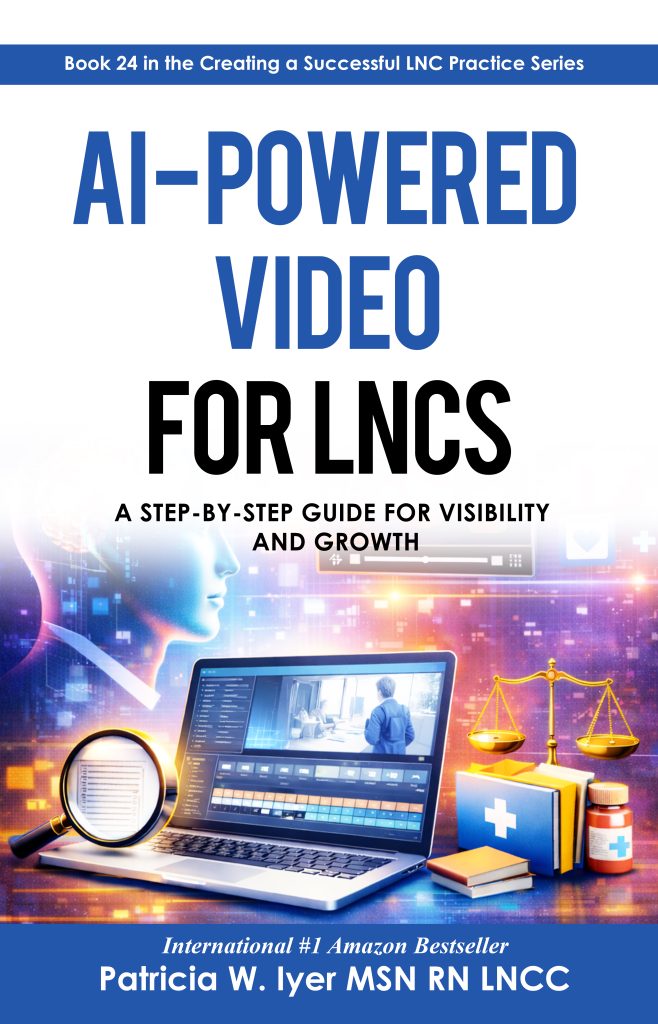
Before you record anything, read your script aloud, all the way through, at the pace you’d actually use. If you stumble over the same sentence twice, rewrite it. If you find yourself skipping a section because it feels unnatural to say, cut it or rebuild it.
Your viewers should hear you, not your writing. Get the script right on the page, and the recording takes care of itself.
Get my AI-Powered Video for LNCs book and workbook here.
Pat Iyer MSN RN LNCC is a consultant, speaker, author, editor and book coach. She has written or edited 73 of her own books and worked with dozens of authors as an editor. Her most recent books are AI-Powered Video for LNCs book and workbook. These books reached Amazon #1 Bestseller status a few days after their release.
Pat is an Amazon international #1 bestselling author. Coaches, consultants, and speakers hire Pat to help release the knowledge inside them so that they can attract their ideal clients.
She delights in assisting people to share their expertise by writing. Pat serves international and national experts as an editor, book coach, and a medical and business writer.