
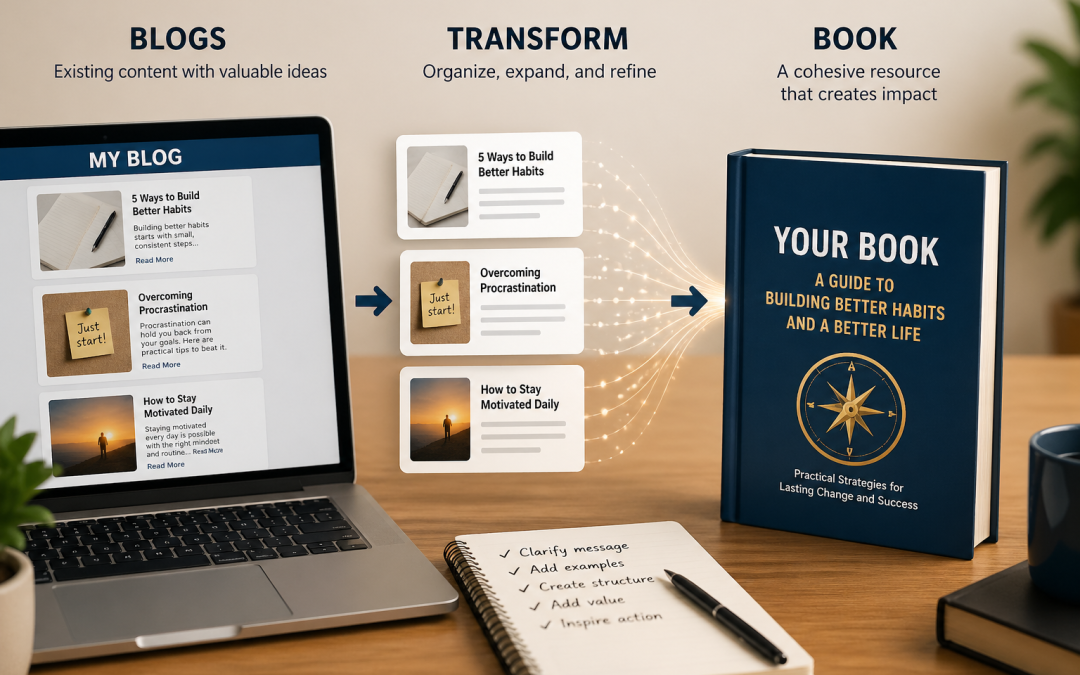
If you’ve been publishing blog posts consistently, you may be sitting on the foundation of your next book without realizing it. Instead of starting from scratch, you can shape your existing content into a focused, valuable short book that reflects your expertise and serves your audience in a deeper way.
When you move your blog to a book, you repurpose your knowledge and gain readers in a new way.
This process is not about copying and pasting posts into a document. It requires thoughtful selection, organization, and refinement so the final product reads as a cohesive, purposeful book—not a collection of unrelated articles.
I’ve created several books from my blog posts. Here, I share a practical roadmap to guide you.
Step 1: Clarify the Audience for the Book
Your blogs on your website are likely all written on the same general topic, and with different audiences in mind. Clearly define who the book is for. For example, if you are a management consultant, is your audience the middle level manager, the CEO, the executive team, or the new hire?
Step 2: Clarify the Purpose of the Book
Before you gather your posts, decide what you want to accomplish with the book. Is it designed to attract clients, educate a specific audience, support your speaking or consulting work, or sell an online course?
A clear purpose will guide every decision that follows—what to include, what to leave out, and how to structure the material. Without that clarity, it’s easy to create a book that feels scattered.
Think in terms of a promise to the reader. What problem will this book help them address? What outcome can they expect?
Step 3: Audit Your Existing Blog to a Book Content
Go through your blog archive and identify posts that align with your chosen topic. You may find that some posts fit perfectly, while others only partially or do not relate to it.
Create a list or spreadsheet of potential posts and group them by theme. As you review, ask:
- Does this post support the main focus of the book?
- Is the information still accurate and relevant?
- Can this content be expanded or updated?
If you are a tactile person, print the posts and arrange them into categories or sequences.
You’ll likely notice gaps as well—areas where you will need to develop additional content to complete the narrative.
Step 4: Create a Logical Structure
A book needs a clear beginning, middle, and end. Once you’ve grouped your posts, outline the chapters in a way that leads the reader through a logical progression.
For example:
- Start with foundational concepts or context
- Move into practical applications or strategies
- Conclude with advanced insights or next steps
I often create sections or parts for my books: Part 1, Part 2, etc. At this stage, don’t worry about perfection. Focus on creating a structure that makes sense from the reader’s perspective.
This is where many people get stuck. Blog posts are often written as standalone pieces, but a book requires flow and continuity. Your outline is the bridge that connects individual posts into a unified experience.
Step 5: Identify Gaps and Fill Them
Your blog posts likely won’t cover everything needed for a complete book. That’s normal.
Look at your outline and identify where transitions are missing or where a concept needs more depth. You may need to:
- Write introduction and conclusion chapters
- Write new chapters or sections to connect ideas
- Add examples, case studies, or stories
- Provide summaries or reflections at the end of chapters
- Draw on other sources of content, such as podcast transcripts
These additions are what turn a collection of posts into a well-rounded book.
Step 6: Rewrite for Consistency and Flow
Even if your posts are well written, they were likely created at different times, with different tones or levels of detail. For example, I’ve been blogging since 2009 and my styles have changed.
Your posts might include calls to action, such as links to lead magnets, upcoming events, or products. You might have guest posts that would not be appropriate to include in your book or will require permission to use.
Edit each piece so the voice, style, and level of detail feel consistent throughout the book. Pay attention to:
- Repetition of ideas across posts
- Shifts in tone or perspective
- References that no longer make sense in a book format (such as “in last week’s post”)
- Mentions of current events that might be forgotten by the time the book is ready
This step is when you make significant changes. You’re not just compiling—you’re refining.
Step 7: Strengthen Transitions Between Chapters
One of the biggest differences between a blog and a book is how the reader moves from one section to the next.
Add introductions, stories, and closing paragraphs to each chapter that guide the reader forward. Help them understand how each section connects to the next.
Think of yourself as leading a conversation. Each chapter should build naturally on what came before.
Step 8: Update and Expand the Content
Your earlier posts may benefit from fresh insights. As you review them, consider:
- What have you learned since writing this?
- Are there new developments in your field?
- Can you add examples or stories that make the content more relatable?
Expanding your content not only improves the quality of the book but also makes it feel current and relevant.
Step 9: Add a Strong Introduction and Conclusion
Your book needs a clear entry point and a satisfying close.
In the introduction, explain:
- Who the book is for
- What it will help them accomplish
- Why you are qualified to guide them
In the conclusion, reinforce the key ideas and encourage the reader to act. This is also a natural place to invite them to connect with you, explore your services, or continue learning from you.
Step 10: Organize Supporting Elements
Consider adding features that enhance the reader’s experience, such as:
- Checklists or summaries at the end of chapters
- Reflection questions
- Practical exercises
These elements increase the usefulness of your book and help readers apply what they’ve learned.
Step 11: Prepare for Publication
Once your manuscript is complete, the final steps include editing, formatting, and designing a cover.
Even for a short book, professional presentation matters. A polished final product reflects your credibility and makes your work more appealing to your audience.
A Final Thought
Turning blog posts into a book is not about taking shortcuts. It’s about building on work you’ve already done and shaping it into something more substantial.
You’ve already invested the time to create valuable content. With a clear plan and careful editing, that blog to a book content can become a book that extends your reach, strengthens your authority, and opens new opportunities.

Pat Iyer MSN RN LNCC is a consultant, speaker, author, editor and coach. She has written or edited 73 of her own books and worked with dozens of authors as an editor. Her most recent books include AI-Powered Video for LNCs book and workbook. She is the author of Blogging for Legal Nurse Consultants: Share Your Knowledge and Attract Clients.
Pat is an Amazon international #1 bestselling author. Coaches, consultants, and speakers hire Pat to help release the knowledge inside them so that they can attract their ideal clients.
She delights in assisting people to share their expertise by writing. Pat serves international and national experts as an editor, book coach, and a medical and business writer.