
Denise had been sending a weekly email to her list for eleven months. Three thousand two hundred subscribers. While she had respectable open rates, she got almost no replies. And when she pulled her book sales report before a conference, she couldn’t point to a single sale she could trace back to those emails.
She showed me a folder of her drafts with subject lines like “New Coaching Package Available” and “Book Your Session Today” and “Limited Spots This Month.” Email after email, all built around the same request: buy something. There was no educational writing.
Nothing in the folder taught her readers anything. Nothing gave them a reason to open the next one. She had trained her own list to skim past her, and she didn’t realize it until the numbers made it impossible to ignore.
This is one of the most common approaches I see among authors, coaches, consultants, and speakers who write to build their audience. They confuse promotional writing with educational writing, and they lean almost entirely on the wrong one.
Two Kinds of Writing, Two Different Jobs
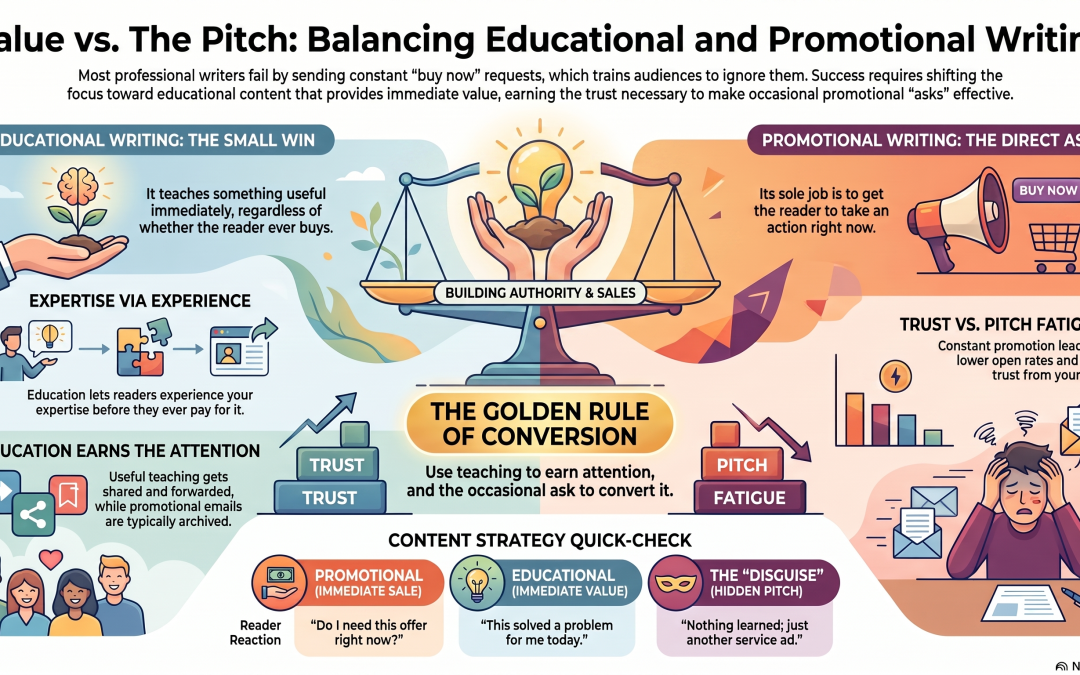
Promotional writing has one job: get the reader to take an action right now.
- Buy the book.
- Register for the workshop.
- Book the call.
I call this the “hire me, hire me, did you know you can hire me” approach.
It’s direct, it’s necessary, and it has its place in every content calendar.
Educational writing has a different job.
- It teaches the reader something they can use immediately, whether or not they ever buy anything from you.
- It answers a real question.
- It clears up a misunderstanding.
- It gives the reader a small win in the middle of their day.
The mistake isn’t writing promotional content. The mistake is writing almost nothing else.
When every email, every post, and every newsletter asks for something, readers stop expecting value and start expecting a pitch. Once that happens, they open less, read less, and trust less.
You can feel this shift happening in your own inbox. Some senders you open automatically because you know something useful is waiting. Others you archive without reading because you already know what’s inside.
Why Constant Promotion Wears Out an Audience
Readers can tolerate a fair number of promotional messages if those messages are surrounded by real value. What they can’t tolerate is a pattern where every single touchpoint asks them for time, attention, or money.
Think about how this plays out with a speaker building a following, or a consultant trying to fill a program. If the only content that reaches an inbox is “here’s my offer,” the reader has no reason to stay subscribed once they’ve decided they don’t need that particular offer right now.
There’s nothing else keeping the relationship alive.
Educational content changes that calculation. A reader who isn’t ready to buy your book today might still open your email next month because last week’s message taught them something they used in a real conversation with a client. That reader stays on your list. That reader eventually buys, often at a point you didn’t try to sell to them at all.
They notice your offer and take advantage of the call to action.
What Educational Writing Actually Builds
Educational writing does something promotional writing can’t: it lets the reader experience your expertise before they ever pay for it. You are showing them you have the skills to assist them.
If you write about the actual mechanics of a well-structured email, a reader can apply that lesson to their own writing that same afternoon. If it works for them, you’ve just demonstrated your knowledge in a way no sales page can replicate. They didn’t take your word for it. They tested it and got a result.
That’s a stronger form of credibility than any list of credentials or client testimonials, because the reader arrived at the conclusion themselves. Business people and readers of every kind trust their own experience more than they trust a claim.
This is also why educational writing tends to be more effective and shareable. A useful, specific piece of teaching gets forwarded and shared in ways a promotional email rarely does. Nobody forwards “buy my book” to a colleague. People forward the piece that solved a problem they were stuck on.
Where the Confusion Usually Shows Up
I see this confusion most often in email newsletters, where the pressure to generate sales makes writers default to pitching in nearly every message. But it also shows up in social media content too, whenever the writing leads with the offer instead of the insight.
A simple way to check your own content: read your last five pieces of writing. Ask what the reader walked away knowing how to do differently. If the honest answer is “nothing, but now they know I have a service available,” that’s promotional writing wearing an educational disguise.
The fix isn’t complicated, though it does take discipline. Most experienced writers aim for a mix where the majority of what they send teaches something concrete, and a smaller portion asks directly for a sale.
The teaching earns the attention. The occasional ask converts it.
The Skill Behind Both
Whether you’re writing to teach or writing to sell, the underlying skill is the same: knowing how to structure a message so the reader keeps reading, understands exactly what you mean, and knows what to do next. That skill is what separates emails that get opened, read, and acted on from emails that get archived without a second look.
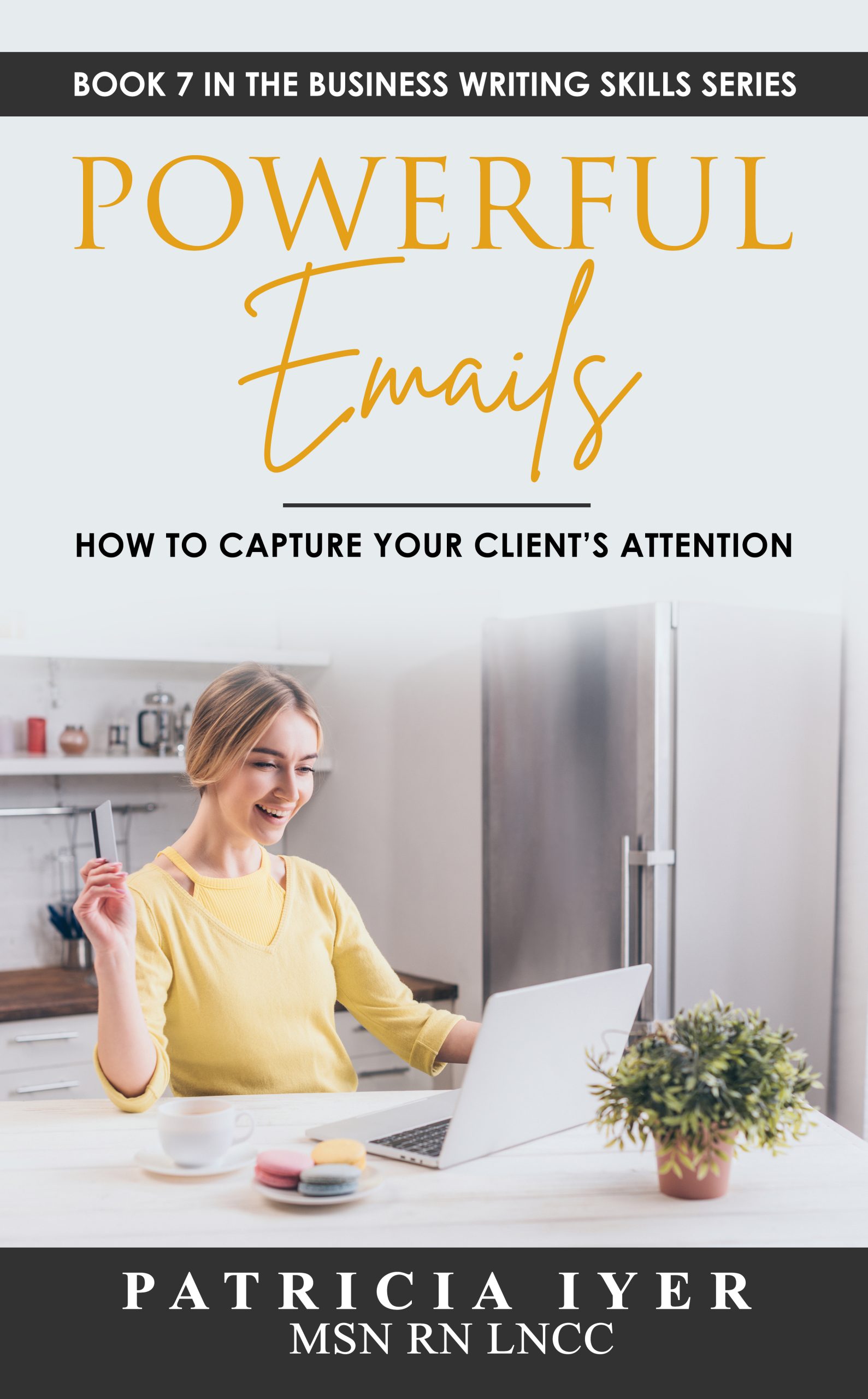 I wrote Powerful Emails: How to Capture Your Client’s Attention to walk authors, coaches, consultants, and speakers through exactly this — how to write the kind of educational content that builds real authority, and how to write the occasional promotional message that doesn’t undo the trust you’ve spent months building.
If Denise’s folder of unread newsletters sounds a little too familiar, this book will show you a different way to write to your list, one message at a time.
Pat Iyer MSN RN LNCC is a consultant, speaker, author, editor and book coach. She has written or edited 73 of her own books and worked with dozens of authors as an editor. Her most recent books are AI-Powered Video for LNCs book and workbook. These books reached Amazon #1 Bestseller status a few days after their release.
Pat is an Amazon international #1 bestselling author. Coaches, consultants, and speakers hire Pat to help release the knowledge inside them so that they can attract their ideal clients.
She delights in assisting people to share their expertise by writing. Pat serves international and national experts as an editor, book coach, and a medical and business writer.