
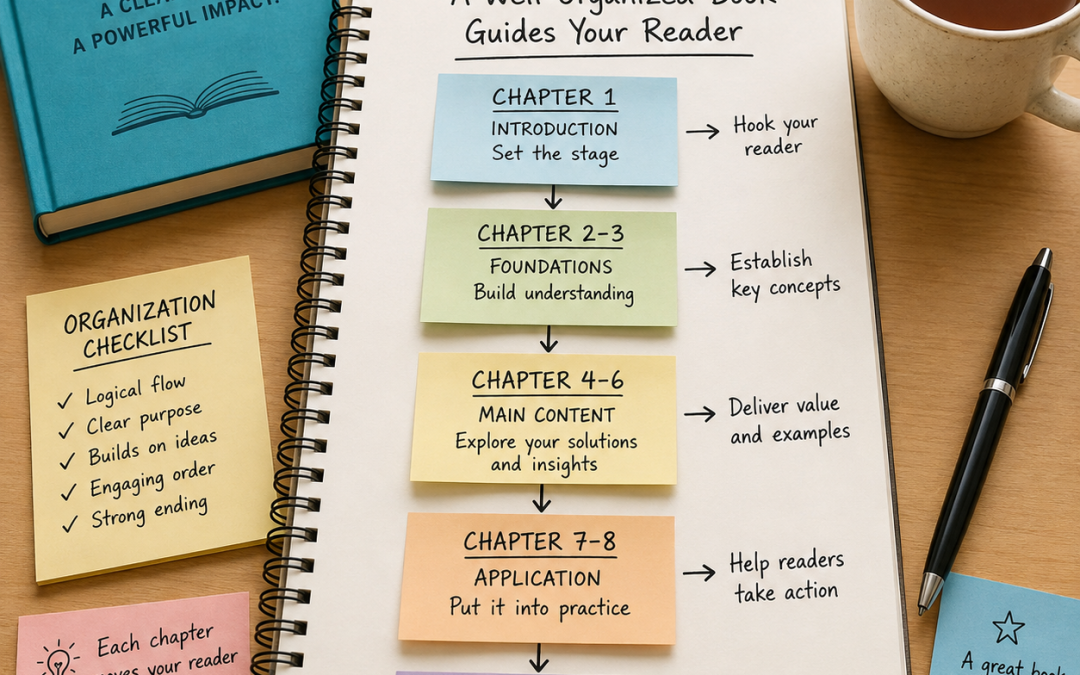
Most authors think the chapter order will show up once they start writing. But it often does not. Ideally, you organize the chapters before you start writing, not during it.
If you wait for the draft to sort itself out, you’ll rewrite the same three chapters five times, in three different orders, before you notice the pattern. Decide the order first, and the writing goes faster, because you always know what comes next.
A Lesson in Why to Organize the Chapters
I saw this with a woman who hired me to edit her book of 101 tips. She’d written all 101 of them, and she couldn’t see how they fit together. They came to me as random files. I grouped them into logical sections, which created a table of contents that held together. She was too close to the material to see how to organize it. That’s what an editor is for.
How to Organize the Chapters
Here are four ways to sequence chapters that work for different kinds of nonfiction books. Pick the one that matches your material, not the one you saw in someone else’s book.
- Sequence step by step. Chapter one teaches the first thing your reader needs to know, and chapter two depends on it. Test every chapter with one question: does the reader need this chapter before they can use the next one? If the answer is no, move it or cut it. This works well for how-to books, where the reader follows your material in order. It’s the easiest structure for a reader to grasp without getting lost.
- Move from broad to narrow. Open with the big picture: the industry, the problem, the stakes. Narrow chapter by chapter until you land on the specific advice your reader came for. A book on leadership might open with what’s broken in most organizations, illustrated with stories the reader will understand. It can end on the one conversation a manager needs to have this week. This works when your topic has layers rather than steps, and the reader needs the context before the tactics make sense.
- Build the book around a word. Pick a word that captures your core idea, and give each letter its own chapter. A book on resilience could use R-I-S-E: four chapters, four ideas, one memorable container. It forces structure onto material that resists a natural order. It also gives your reader something to repeat back to you long after they close the book. Save this one for material that doesn’t already have a natural sequence.
- Sort by the questions you get asked. List the ten questions your clients ask you the most and turn each one into a chapter. You already know the order. It’s the order they ask you the questions in real life. A reader who came looking for answers will recognize their own question in your table of contents. This method writes itself once you have the list.
Consider the difference between frequently asked questions and should ask questions. Frequently asked questions are the questions your readers or clients actually ask you, out loud, already. You’re not inventing anything — you’re mining your inbox, your consultations, your Q&A sessions for the questions that come up again and again and turning each one into a chapter. The order comes from real conversations.
Questions readers should ask are the ones they don’t know to ask yet — the reflective or diagnostic questions that get them from confusion to clarity, but a beginner in your field wouldn’t think to voice them on their own. You’re not reporting what happened; you’re constructing the questions a step ahead of the reader, based on what they need to figure out at each stage.
Here is the practical difference for organizing chapters: FAQ-based structure is reader-validated (you know people care about these questions, because they asked). “Should ask” structure is author-imposed (you’re teaching the reader what to worry about, in an order you’ve decided matters). FAQ risks feeling like a grab-bag if the questions don’t build on each other. “Should ask” risks feeling presumptuous if the reader doesn’t yet trust that these are the right questions.
None of these models to organize the chapters must work alone. A business book can open with the broad view of the problem, run step by step through the middle, and close with a chapter built from your most common client question.
What matters is choosing and mapping your content purposefully, before you write chapter one. Test every chapter against your reader’s actual need, not your own sense of what belongs.
If you skip that step, you’ll write the chapters you find easiest, in whatever order the ideas occur to you. The result reads like a collection of loose notes, confuse the reader, and result in the reader putting the book aside.
A book without a structure looks a lot like furniture assembled without a plan or by trying to follow incomplete instructions. Every screw and every hole is there, and it still comes out looking wrong. Readers notice a book that wanders around the topic. Even when they can’t say why the material frustrates them, they put it down before they finish it. An outline is what keeps that from happening, and it takes far less time to build than a rewrite does.
Organize the chapters before you write a single page, and the rest of the book gets easier.
Authors work with me as a book coach to help them accomplish their goal of getting that book written. Let’s talk about how I can help you. Email me at pat at patiyer dot com, or reach me through the contact form at patiyer.com.
Pat Iyer MSN RN LNCC is a consultant, speaker, author, editor, and book coach. She has written or edited 73 of her own books and worked with dozens of authors as an editor and book coach.